
Pump lines
Pump without a seal.
All three lines share the same magnetic coupling, the same slotless BLDC motor, and the same integrated drive. Selection is by position in the loop. The hydraulics are matched to a duty point, not picked from a catalog.
All three lines are in sampling and limited production today. Within the platform envelope, hydraulics, porting, controls, and form factor are built to order, which is what the OEM line exists for.

The range
| Line | Power | Bus | Drive | Typical position |
|---|---|---|---|---|
| Rack CDU Pumps | 0.10 to 2.0 kW | 12 to 800 V DC | AC and DC | In-rack and sidecar CDUs |
| Row & Facility Pumps | 1.0 to 5.0 kW | 12 to 800 V DC | AC and DC | Row CDUs, coolant skids, facility loops |
| OEM Custom Solutions | Co-engineered | To your architecture | AC and DC | Built around your platform |
Power and bus voltage bound the range. They are not selection parameters. Hydraulic performance is set per application, covered below.
- Rack CDU Pumps
- Cool the rack with nothing to leak into it. Compact seal-less pumps engineered for in-rack and sidecar CDUs. Quiet, redundancy ready, and tuned for direct-to-chip loops at the rack level.
- Row & Facility Pumps
- Facility-scale flow, still one part number. High flow, high head pumps for row-level CDUs, coolant distribution skids, and facility water loops. Integrated drive electronics across the full bus range.
- OEM Custom Solutions
- Your platform. Your badge. Our hydraulics. Co-engineered pump assemblies for CDU and rack OEMs. Custom hydraulics, controls, telemetry, and form factors, with private label and supply agreement options.
Common to every line
- Status
Sampling and limited production
Sampling means units are available for evaluation. Limited production means we are building to order at low volume rather than from stock. It is worth asking what the current output and the next step look like before designing a platform around any supplier.
- Coupling
Magnetic, across a sealed containment barrier
Torque is transmitted through a solid containment barrier by magnets on either side of it, with no shaft crossing the boundary. The limit of this arrangement is a maximum transmissible torque: beyond it the two rotors slip out of synchronisation and the impeller stops following the motor.
- Insulation
Class B
The thermal class of the winding insulation system, which sets how hot the winding may run continuously. Class A is 105 °C, B is 130 °C, F is 155 °C and H is 180 °C. The relevant figure is the total of ambient plus temperature rise, so a warm coolant loop eats into the margin.
- Dynamic seals
None in the fluid path
A dynamic seal is any seal that rides against a moving surface, such as a mechanical face seal or a lip seal on a rotating shaft. It is a sacrificial contact surface and a consumable. Static gaskets and o-rings, which do not move against anything, are a different thing and are still present.
- Dry running
Tolerated
Operating with no fluid in the wet end. It happens in practice when a loop is commissioned before it is filled, or when a pump loses prime in service. Many seal-less designs cannot survive it, because the fluid is doing the bearing lubrication or cooling.
- Motor
Slotless BLDC, designed and wound in house
A slotless BLDC motor has no iron teeth between the windings and the magnets. That removes cogging torque, which is the reason a conventional brushless motor pulses slightly as it turns, and it changes the acoustic signature. It also means the winding is designed rather than wound into a fixed slot geometry.
- Drive
Electronics and controls integrated in the assembly
Whether the assembly runs from AC distribution, a DC bus, or both. AC suits existing facility power and retrofits; DC suits modern rack architectures. Supporting both is what lets one platform serve a retrofit and a new build.
- Speed control
Variable, modulates to load
Variable speed means the pump follows the thermal load instead of running flat out and being throttled. Since pump power scales roughly with the cube of speed, modest speed reduction produces a large power saving across a realistic duty profile.
- Redundancy
N+1, 2N, active-active load sharing, hot-swap
N+1 is one spare beyond what the duty requires. 2N is full duplication. Active-active load sharing runs both pumps below rated duty so either can carry the load alone. Hot-swap means a unit can be replaced without taking the loop down. Which one applies is usually set by facility policy, not by the pump.
- Country of origin
United States
Where the goods are manufactured, which drives duty treatment, trade-agreement eligibility, and in some cases federal procurement rules such as Buy American provisions.
Private label and supply agreements
The OEM line exists because most CDU and rack builders do not want a catalog pump with somebody else’s badge on it. Custom hydraulics, controls, telemetry, and form factor are all in scope, as are private label and long-term supply terms.
If you are designing a platform and not sourcing a part, say so when you get in touch and we will scope it properly.
Specifying a pump
We do not publish a fixed curve per model, because there is no single curve to publish. Hydraulic performance depends on the duty point you need, the inlet and outlet configuration, the fluid and its glycol concentration, the operating temperature, and the bus voltage available. Change any one of those and the curve moves.
So the curve comes out of the engineering conversation, not before it. Send the loop conditions and we will return the performance you would actually get in your system, at your operating point, with your fluid. If the platform cannot reach it, we say so. No best case off a test rig.
Partial information is fine to start. A duty point and a fluid is enough for a useful first answer.
What to send
The more of this you have, the shorter the path to a real answer.
- Duty point
- Required flow in GPM and the head or pressure drop in PSI it has to overcome. Metric is fine too.
- Loop connections
- Inlet and outlet size, orientation, and fitting type
- Fluid
- Water, PG or EG, and the glycol concentration by volume
- Temperatures
- Supply and return temperature, and the maximum the pump will see.
- Available power
- AC distribution or DC bus, and the bus voltage
- Envelope
- Space available and any mounting or orientation constraint
- Redundancy scheme
- Single pump, N+1, 2N, active-active, or hot-swap
- Controls
- Speed command and telemetry your system expects
- Volume and timing
- Expected annual quantity and the program milestone dates
Send it to info@aviemoretech.com. An engineer who has built these pumps will answer, and the first reply is technical, not a request for a meeting.
Documentation
Everything below exists and is released per configuration once it is characterized. Ask for the ones you need and say which application, and we will send what applies to your duty point.
- Performance curve
- Flow against head at your fluid, temperature, and bus voltage
- Specification sheet
- Ratings, materials, interfaces, and operating limits
- Envelope drawing
- Overall dimensions, port positions, mounting centers
- 3D model
- STEP file for design-in
- Controls interface
Speed command and telemetry available on the assembly
How the host system commands speed and reads back status. Common schemes are a PWM or 0 to 10 V speed input with a tachometer output, or a digital bus such as PMBus or I2C where the pump reports speed, power, and fault state.
- Test data
- Results for the configuration under discussion
Request any of these at info@aviemoretech.com, or leave an address below and we will send them as each configuration is released.
Get the performance data
Hydraulic curves, spec sheets, and CAD are released as each configuration is characterized. Leave an address and we will send the data for the application you care about when it is published. No marketing sequence, no weekly email.
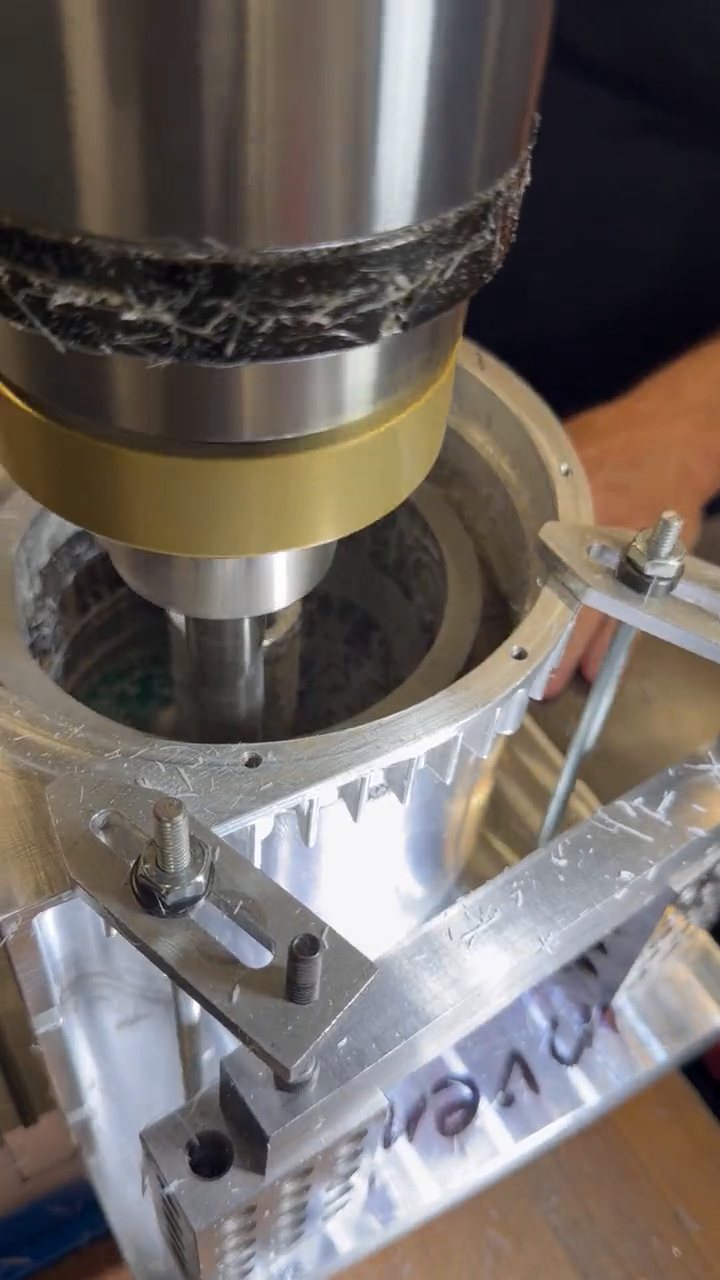
Boring a housing
That is one of our own motor housings, clamped on a mill table in Radford with a boring head above it. The fins were cut on the same machine.
It is a small thing to show and an important one to understand. Because the housings are cut here, a dimensional change is a fixture setup and an afternoon, not a quote from a supplier and a place in their queue. That is the whole reason a requirement change turns into a new design in weeks.
Manufacturing
Most companies bringing a new pump architecture to market are shopping for a contract manufacturer. We are not. Motor winding, machining, assembly, and test all run in a 156,000 square foot building we own in Radford, Virginia.
In practice this is what determines whether lead times and change orders behave. A revision to a housing, or a rewind at a different turn count, is a conversation with the people down the hall, not a purchase order into somebody else’s queue.
It also means the motor, the drive electronics, and the hydraulics are developed together, not integrated after the fact, which is the only reason a single assembly with one part number is possible at all.


- Facility
- 156,000 sq ft
- In house
- Motor winding, machining, assembly, test
- Motor platform
- Same slotless design and technology, 16,000+ motors shipped
- Field record
Zero motor defects
Observed reliability in service, as distinct from a calculated figure such as MTBF. Worth asking over what population and what period any such number was measured.
- Approvals
UL and Intertek certifiable on request, CAGE and UEI registration pending
Third-party marks and registrations. Certifiable on request means an assembly can be taken through UL or Intertek certification against the standard your program needs, so tell us which ones apply. CAGE and UEI are the identifiers federal buyers need, and ours are in process.
- Country of origin
United States
Where the goods are manufactured, which drives duty treatment, trade-agreement eligibility, and in some cases federal procurement rules such as Buy American provisions.